DevOps Automation & CI/CD Pipelines
GitHub Actions or CircleCI pipelines, Terraform-managed infrastructure, ArgoCD-driven deploys -- typically daily deployments within 90 days.
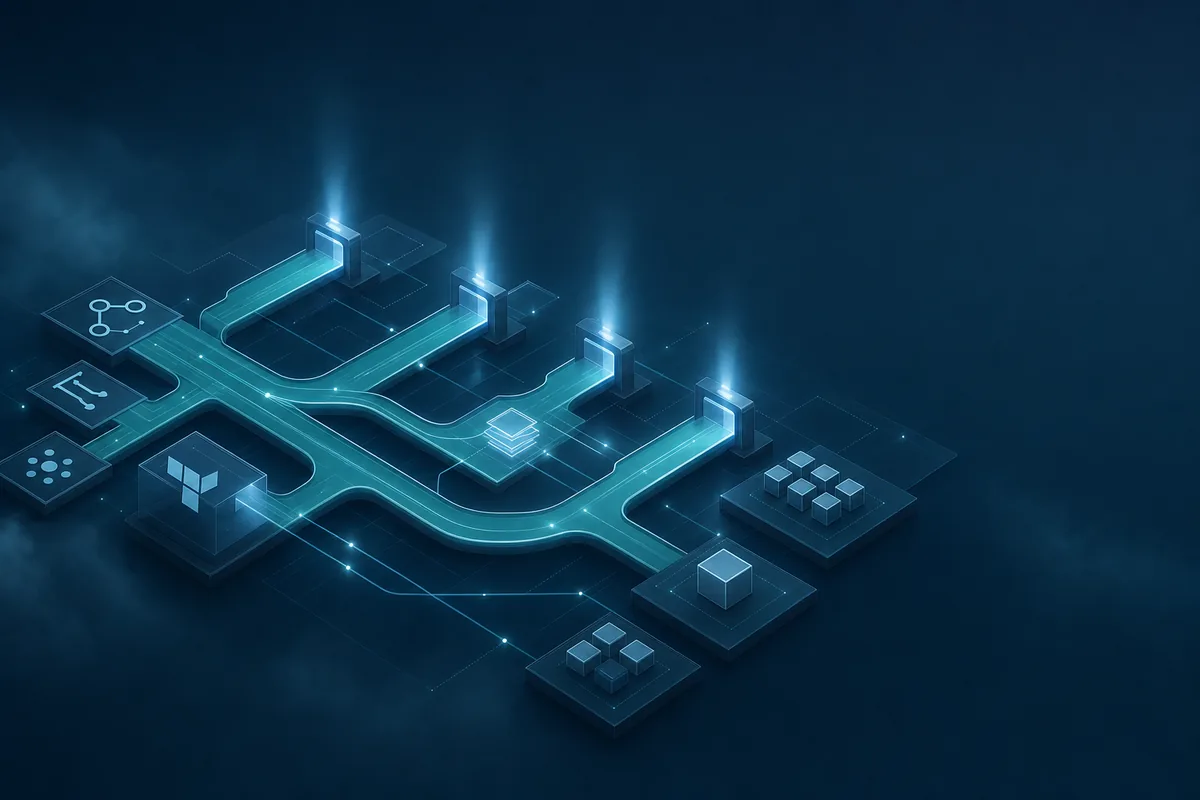
Faster, Safer Deployments
DevOps at Jacobian is opinionated. We pick one CI platform per customer (typically GitHub Actions for GitHub-hosted repos; CircleCI or Buildkite when scale, parallelism, or self-hosted runners require it) and build the pipeline as code -- versioned, code-reviewed, and reusable across services. Build, test, security scan, and deploy stages all run in containers with pinned tool versions, so the same pipeline that runs locally runs in CI and in production.
Infrastructure ships as Terraform from the same repos. Modules are versioned, change plans are previewed in pull requests, and apply happens through a protected workflow with manual approval for production. For Kubernetes workloads we layer ArgoCD or Flux for GitOps-driven deploys -- desired state lives in Git, the cluster reconciles automatically, and rollbacks are a single revert. Most customers reach daily deploys within 90 days.
Security scanning is integrated, not bolted on. SAST (CodeQL, Semgrep), SCA (Dependabot, Snyk, or GitHub Advanced Security), container scanning (Trivy, Grype), and IaC scanning (Checkov, tfsec) run on every PR. Failed scans block merges; remediation is tracked. Because our team's roots are in audit and compliance work, the same pipelines that ship code also produce evidence -- signed builds, deployment logs, and approval records that satisfy SOC 2 change-management controls without a separate compliance toolchain.

Why Choose Our DevOps Automation & CI/CD Pipelines
Engineering rigor, audit-ready process, and operational depth across cloud, SaaS, and software delivery
Speed
GitHub Actions or CircleCI pipelines tuned for fast feedback -- typical PR-to-staging deploy under 10 minutes; daily production deploys within 90 days of engagement.

Reliability
ArgoCD or Flux-driven GitOps means desired state lives in Git, the cluster reconciles automatically, and rollback is a one-click revert. Failed deploys roll back in under 5 minutes.

Security
SAST (CodeQL, Semgrep), SCA (Dependabot, Snyk), container scanning (Trivy), and IaC scanning (Checkov) on every PR. Signed builds and deployment logs satisfy SOC 2 change-management controls.

Our DevOps & MLOps Process
From assessment to automation, we guide your DevOps and MLOps journey.
Assessment & Tool Selection
Two-week review of your repos, current CI/CD, deployment cadence, and security posture. Output: tool selection (GitHub Actions vs CircleCI vs Buildkite), pipeline architecture, and a 60-day rollout plan.
Pipeline & IaC Implementation
Days 15-45: build pipelines as code, migrate infrastructure to Terraform with module versioning, integrate security scanning (CodeQL, Snyk, Trivy, Checkov), and set up GitOps deploys for any Kubernetes workloads.
Cutover & Team Enablement
Days 45-60: production cutover with feature-flagged rollback, runbook documentation, and pairing sessions with your engineering team. Hand off documentation and a 30-day support window before steady-state.
Assessment & Tool Selection
Two-week review of your repos, current CI/CD, deployment cadence, and security posture. Output: tool selection (GitHub Actions vs CircleCI vs Buildkite), pipeline architecture, and a 60-day rollout plan.
Pipeline & IaC Implementation
Days 15-45: build pipelines as code, migrate infrastructure to Terraform with module versioning, integrate security scanning (CodeQL, Snyk, Trivy, Checkov), and set up GitOps deploys for any Kubernetes workloads.
Cutover & Team Enablement
Days 45-60: production cutover with feature-flagged rollback, runbook documentation, and pairing sessions with your engineering team. Hand off documentation and a 30-day support window before steady-state.
Manual vs. Automated DevOps
See the impact of automation on your software delivery.
| Feature | Manual | Automated |
|---|---|---|
| Deployment Cadence | Weekly or slower, gated on manual approvals | Daily, gated on automated test plus security pass |
| Rollback Speed | Hours to revert and redeploy by hand | Under 5 minutes via GitOps revert |
Deployment Cadence
Rollback Speed

DevOps Best Practices Guide
A practical guide to modern DevOps automation.
Read the whitepaperDevOps & MLOps FAQs
Common questions about DevOps automation and ML deployment pipelines.
Related Services
Buyers of devops automation & ci/cd pipelines typically partner with us across these adjacent disciplines
Cloud Infrastructure Management
CI/CD pipelines deploy into infrastructure that we also designed and operate — fewer handoffs, tighter feedback loops between platform and product engineering.
Monitoring & Incident Response
Automated deploys are only safe with observability that catches regressions immediately — Datadog, PagerDuty, and on-call SRE coverage.
Penetration Testing
Security scanning in the pipeline is a first defense; periodic third-party penetration testing is the second. Both inputs feed the same remediation queue.
Ready to Automate Your DevOps?
Book a free DevOps assessment.